
B-29 - Hero Or Devil?
They're either one of the most famous airplanes in the world, or one of the most infamous. It all depends on your point of view.
My dad was stationed in Australia and the Philippines during WWII. Whenever we asked him what he did during the war, he would tell us he sharpened pencils. This was unsatisfying to a young boy - there just had to be more to it than that. After the Japanese secret codes were declassified, we found out he’d been one of the Army Signal Corps cryptographers who decoded them. That was important, yes, but a little boring. After reading retired colonel and military historian Trevor Nevitt Dupuy’s WWII histories in my grade school library, I was increasingly interested in the airplanes that fought over Europe and the Pacific. That was much more interesting. I built small scale models of many of them, including the four-engined B-17 and B-29.
On a road trip to Washington DC, I had a chance to see WWII warbirds up close. We stopped at Dayton, Ohio's Museum of the Air Force and the Smithsonian's Steven F. Udvar-Hazy Center in Chantilly, Virginia. B-29 Enola Gay was on display at Udvar-Hazy Center and B-29 Bockscar was at the Museum of the Air Force, both in static, non-flying exhibits. These two airplanes delivered atomic bombs over Japan during WWII. I've also photographed B-29 Doc a couple times over the years, especially at his home hangar in Wichita. Doc is one of just two B-29s still flying.
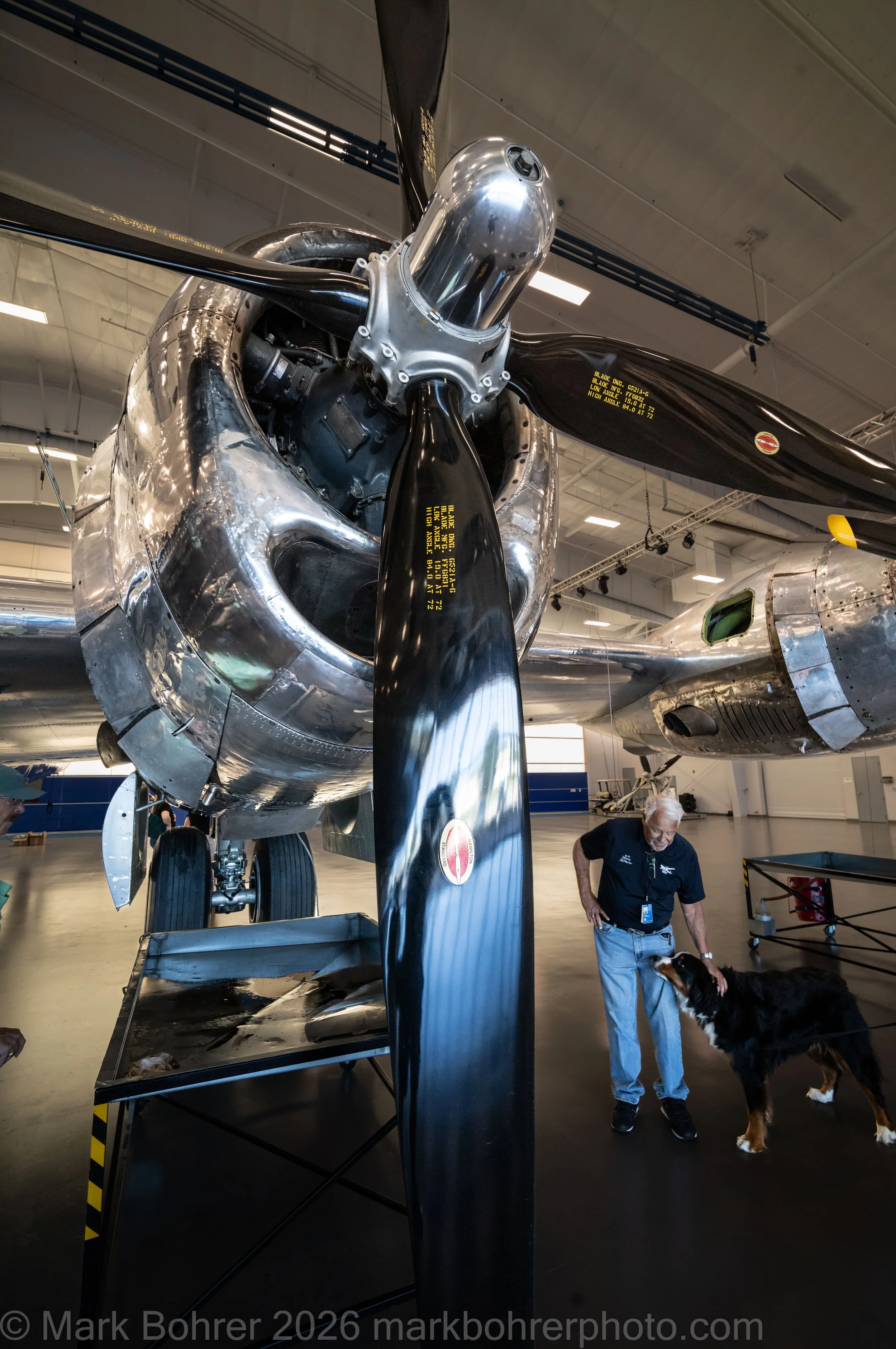
B-29 Doc is pretty big - one engine and prop next to a human guide and Bernese Mountain Dog Taylor
Where They Came From - Hap Arnold and the Push For a Superbomber
General Henry “Hap” Arnold was a 1907 West Point graduate. He was assigned to the Army Signal Corps and sent to the Wright Brothers in April 1911 to learn to fly. He became one of the first military aviators later that year. The Air Service Arnold served in was split out of the Signal Corps in 1918, and became the Army Air Corps in 1926.
After many successful assignments and promotions, Arnold was appointed head of the Air Corps in 1938. Following several conversations with disgraced general Billy Mitchell, Arnold was convinced high altitude precision bombing could prove decisive in any major conflict. He also dreamed of the Air Corps as a co-equal branch of the US armed forces, not just a part of the Army. So he pushed for a bomber that could fly higher, faster and farther than the B-17, B-24 or British Avro Lancaster, hoping to use a successful heavy bomber as leverage for an independent air force.
Boeing offered the B-29 in response to the Army Air Corps' 1939 formal specification for a so-called "superbomber." The company had started design of a relatively fast, long range bomber with a heated, pressurized cabin in 1938, something that had never been done before. The B-29 proposal won the contract, and further development led to the first XB-29's maiden flight in September 1942. This aircraft had three-bladed props and no defensive armament - no top or chin / bottom turrets, no rear machine guns, just a prototype. That first flight went very well, but the second prototype crashed and burned on the next flight after problems with an engine fire. The plane was promising enough that a third prototype was flown, then used as a testbed (and eventually was part of the production line configuration in Wichita). Hap Arnold directly intervened to get the new bomber developed, bugs worked out and released to production in April 1943, a very fast development for any military airplane.
The production B-29 had upgraded engines and four-blade props, five remote-controlled turrets and a rear gun position with two machine guns and a 20mm autocannon. The first B-29s began flying missions out of India to bomb Japan in June 1944. Around 3987 were built and flown during WWII. Of these, a small number were modified to carry 10,000 pound payloads. They had all five turrets and defensive armor plating removed to save weight and reduce drag, plus more powerful engines, all of which increased maximum speed to allow the plane to escape after bombing. The only defensive armament was the rear machine guns. There were also bomb bay and bomb release modifications, to speed up operation of the bomb bay doors and allow for a larger bomb size. These were the so-called Silverplate bombers designed to carry atomic bombs. No other airplane in the US arsenal could have delivered them.
Paul Tibbets and the Silverplate B-29
Colonel Paul Tibbets requested and oversaw the changes necessary for Silverplate B-29s, working with Manhattan Project scientists after it was decided to use the B-29 as the atomic bomb delivery vehicle. As leader of the 509th Composite Group tasked with delivery of the bomb, he and his group trained extensively at Utah's Wendover Air Force Base, dropping conventional 'pumpkin' bombs modeled after the actual atomic weapons. Tibbets was closely involved with mission planning. Silverplate was the magic word - all Tibbets had to do was request something needed for Silverplate, and he got it.
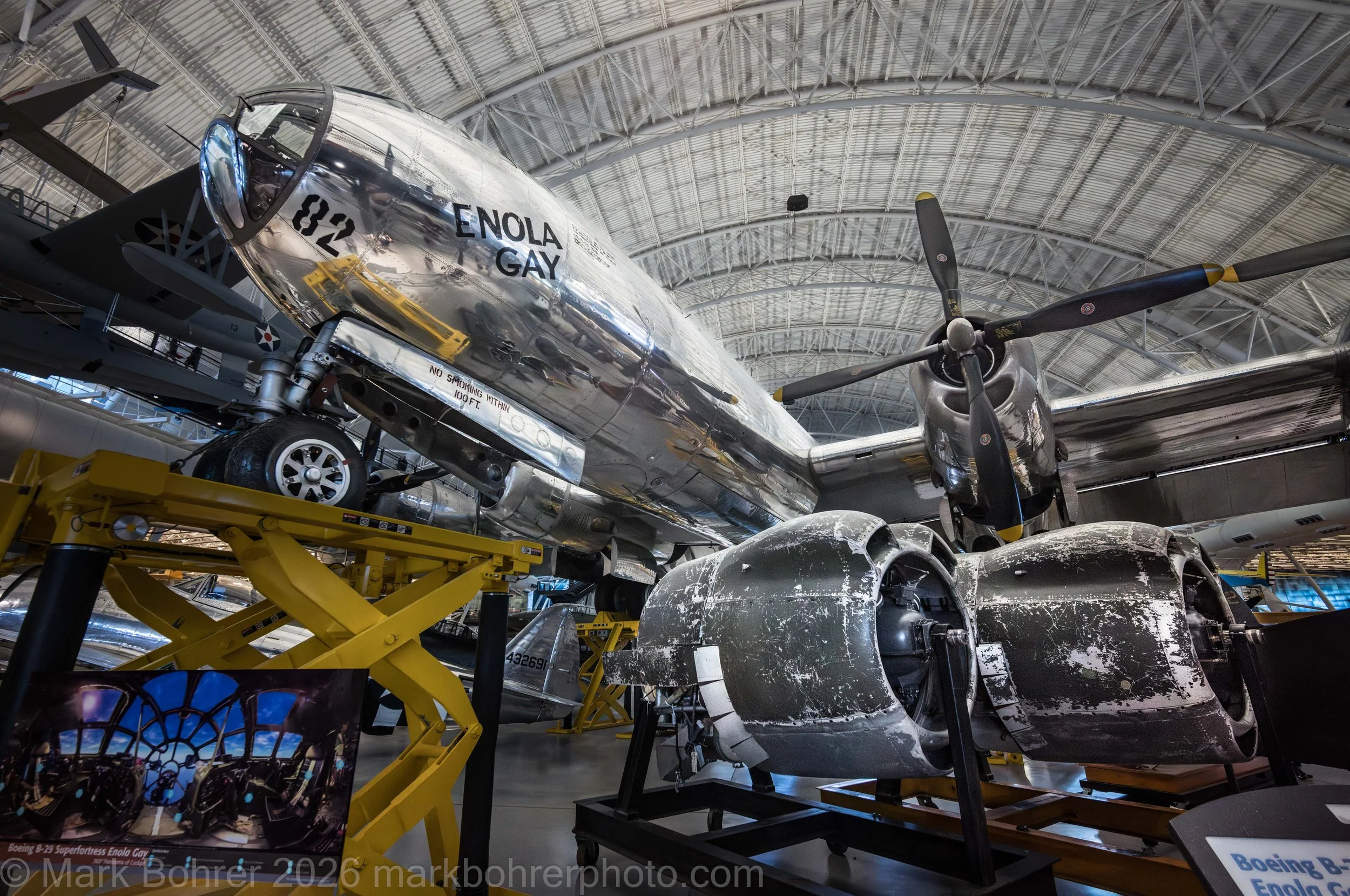
B-29 Enola Gay at the Smithsonian National Air and Space Museum, Steven F. Udvar-Hazy Center
On August 6, 1945, Tibbets piloted B-29 Enola Gay over Hiroshima as it dropped the first atomic bomb. Three days later, Major Charles Sweeney piloted B-29 Bockscar to drop the second bomb over Nagasaki. The second bomb’s primary target had been Kokura, but cloud cover and smoke there caused the diversion to Nagasaki. Five days after the Nagasaki bombing, on August 15, Emperor Hirohito announced Japan's unconditional surrender to the Allies, ending WWII. It was estimated that an invasion of Japan would have resulted in 250,000 to one million casualties for each of the Allies and Japan. Those estimates led to President Harry Truman’s decision to use the atomic bomb to avoid losing more men.
My dad told us he and his fellow soldiers used to say, “The Golden Gate in ‘48.” That was when everyone thought they would get home from WWII before the atomic bomb.
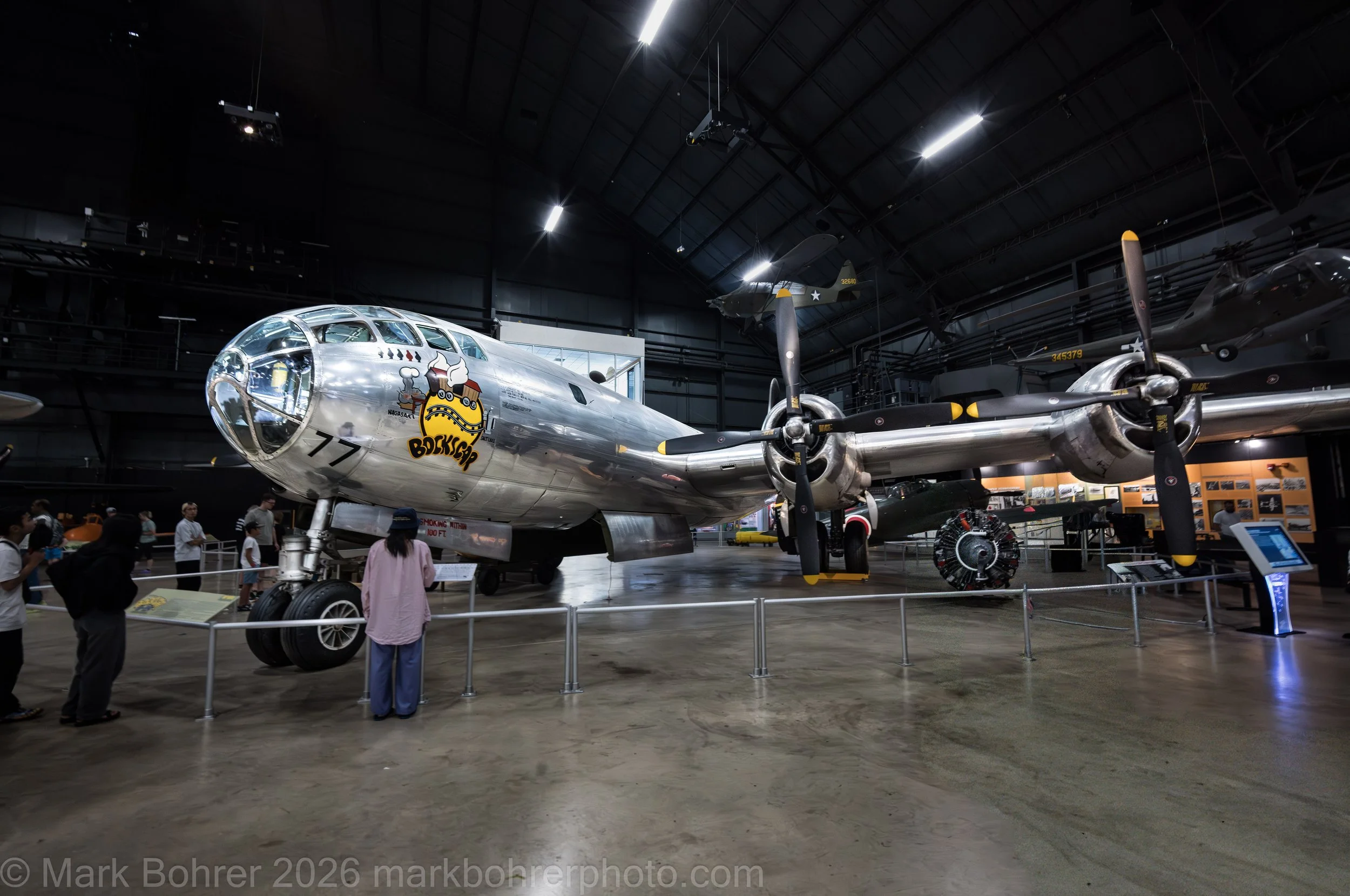
B-29 Bockscar at the Museum of the United States Air Force, Dayton, Ohio
B-29 Doc
B-29 No. 44-69972 was delivered to the US Army Air Force in March 1945, but did not see active combat in WWII. Instead, it was converted to a radar calibration aircraft in 1951 and stationed at Griffiss Air Force Base (now Griffiss International airport) near Rome, New York. Doc was part of the 9-plane Seven Dwarfs squadron of radar target planes, used to test radar tracking accuracy. The Seven Dwarfs squadron became bomb targets for training at the China Lake Naval Air Weapons Center in California in March, 1956.
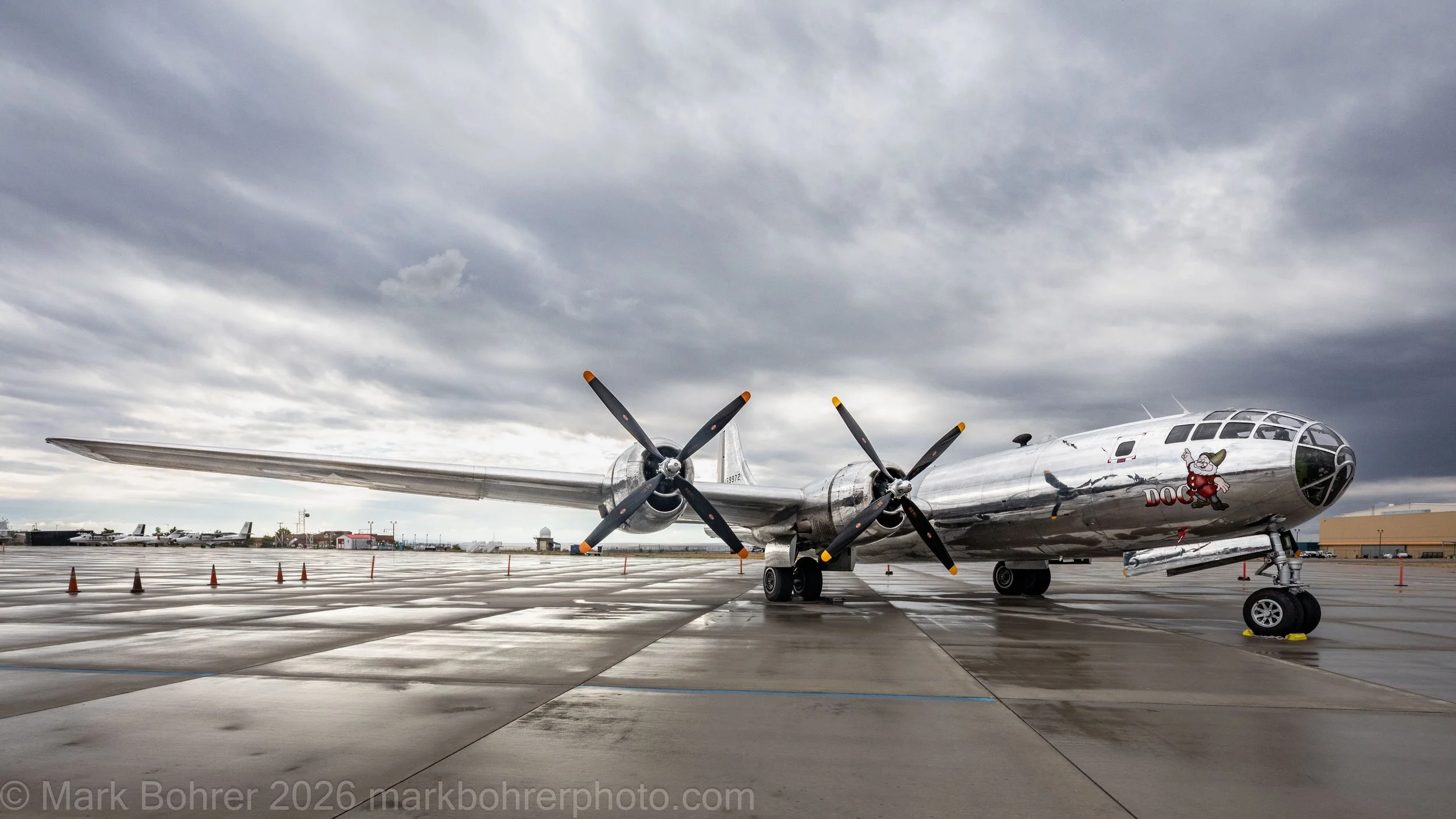
B-29 Doc on the tarmac in Albuquerque - EOS 5D mk IV camera, TS-E 17mm f/4L
Doc was stored in remote Area R in the Mojave Desert for the next 42 years, and remained relatively intact. Air Force veteran and former B-29 flight engineer Tony Mazzolini found Doc in 1987, and started a plan to restore the plane to flying status. Mazzolini had offered to buy Doc outright, but the Navy said no. What they wanted was a restored Dolittle Tokyo Raider-style B-25 in trade - then they later changed their minds and asked for a naval PBJ variant. First Mazzolini had to find a B-25 (he got it in Venezuela), then restore it as a PBJ model to trade. That took 6 years. Then there was disassembly and transportation of B-29 Doc from his remote desert location to Wichita on seven flatbed trailers in 2000.
Many former personnel from Boeing's wartime Wichita factory were recruited to help restore the plane. After 17 years of work, Doc took his first flight in 2016. Non-profit Friends of Doc broke ground on a hangar to house the restored plane in 2017, and Doc rolled into his new hangar in November 2018. His journey was complete.
Today, Doc's mission is to honor the WWII sacrifices of the Greatest Generation, connect people with the rich heritage of the B-29, and allow aviation enthusiasts to experience a B-29 up close. Doc averages 150 flight hours every year, mostly between early April and late October.
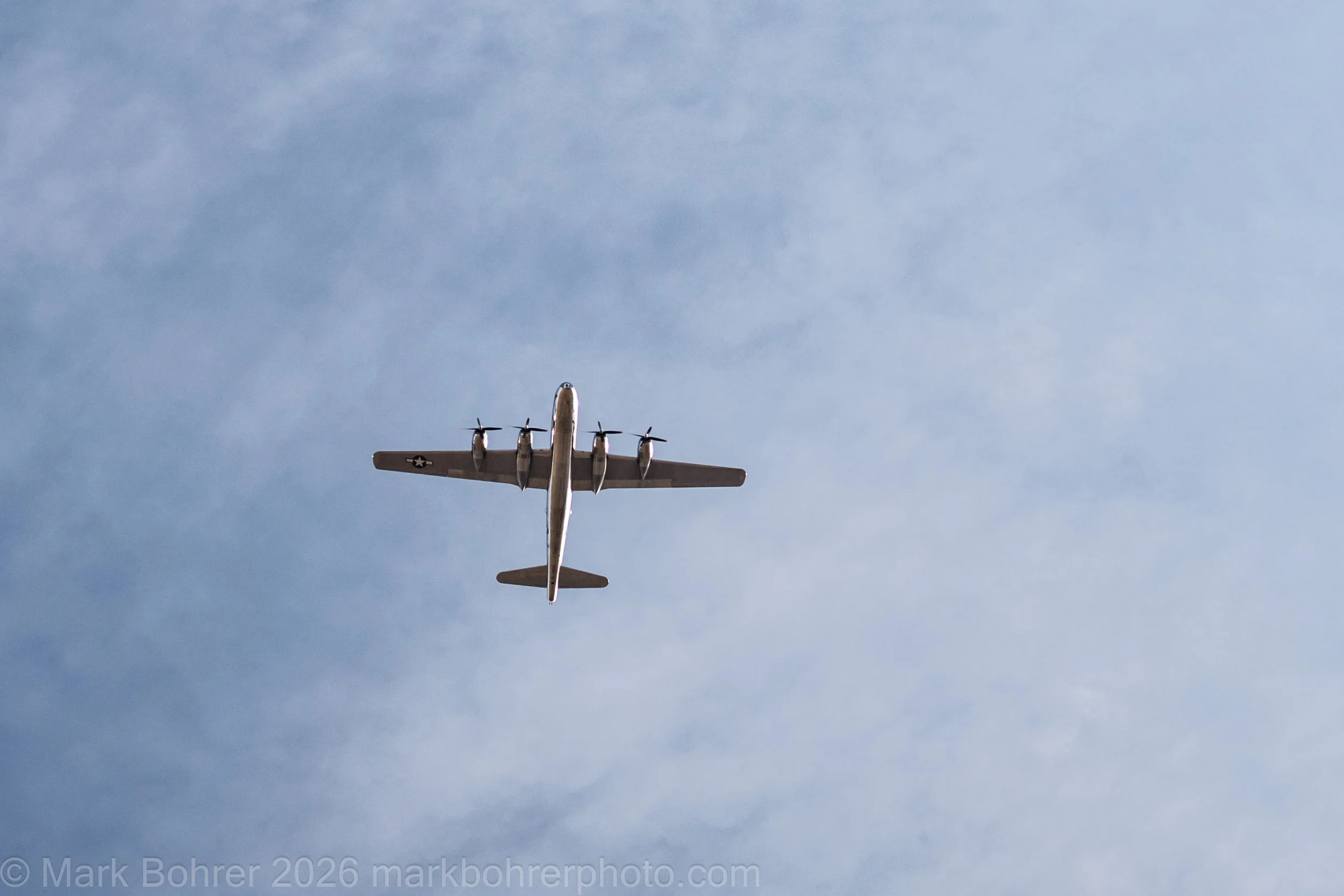
B-29 Doc overhead
I first saw Doc flying overhead when I was leading a photo tour in Albuquerque's Petroglyph National Monument. I'd seen and photographed B-17G Nine-O-Nine and B-24J Witchcraft before, and knew this was a different plane. There was a news story about Doc's visit to Albuquerque stating where he'd be, so I went out to the airport to photograph him. After all, it isn't every day you see a B-29 casually parked on the tarmac at a commercial airport!
Up Close And Personal In Wichita
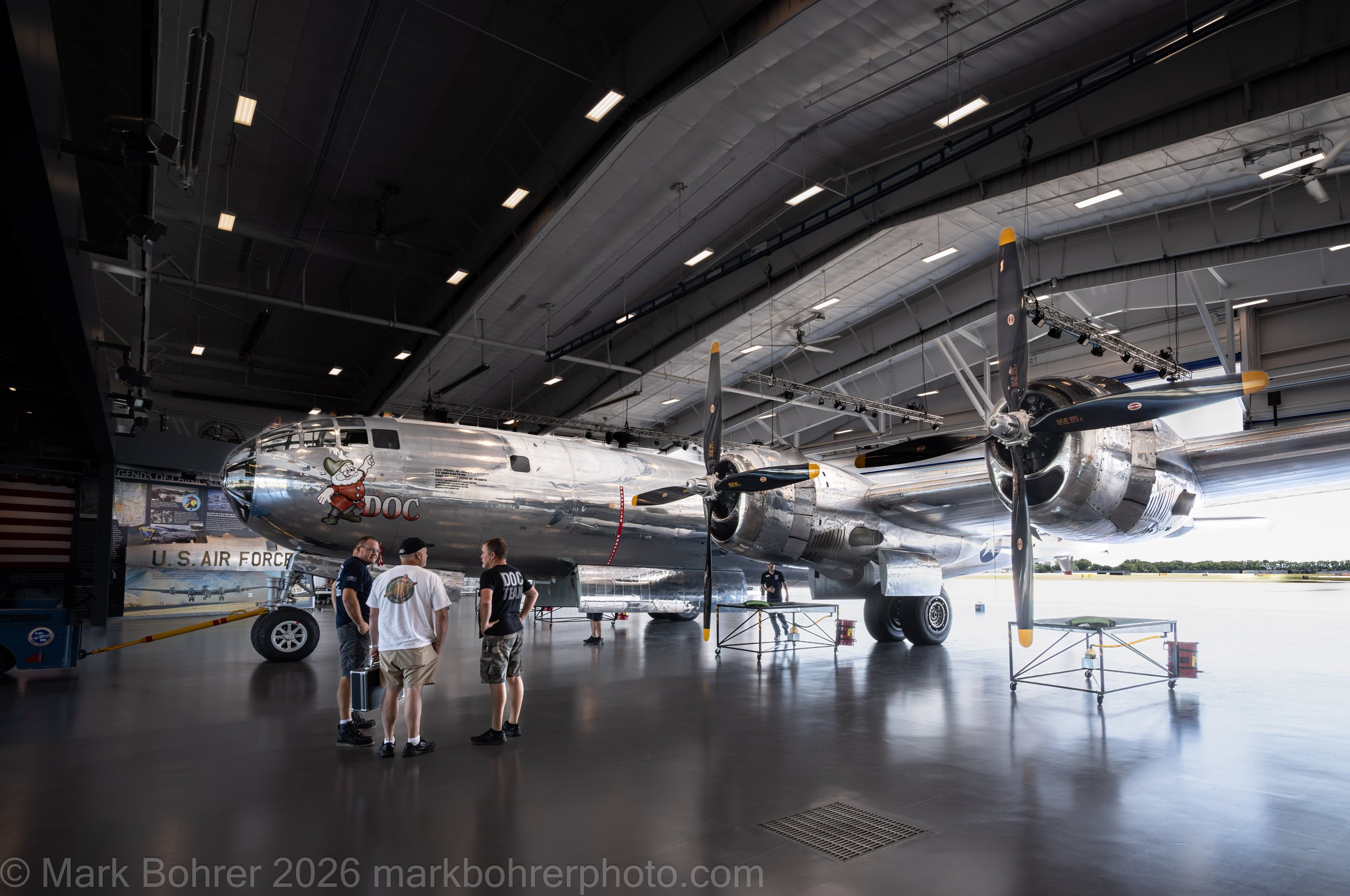
A big plane…
Driving through Wichita on a trip to the Chicago area a few years later, we decided to visit Doc in his hangar. When you get up close, you realize just how big this airplane is. I'm always amazed that a 133,000 pound aircraft can get off the ground and fly, but it does.
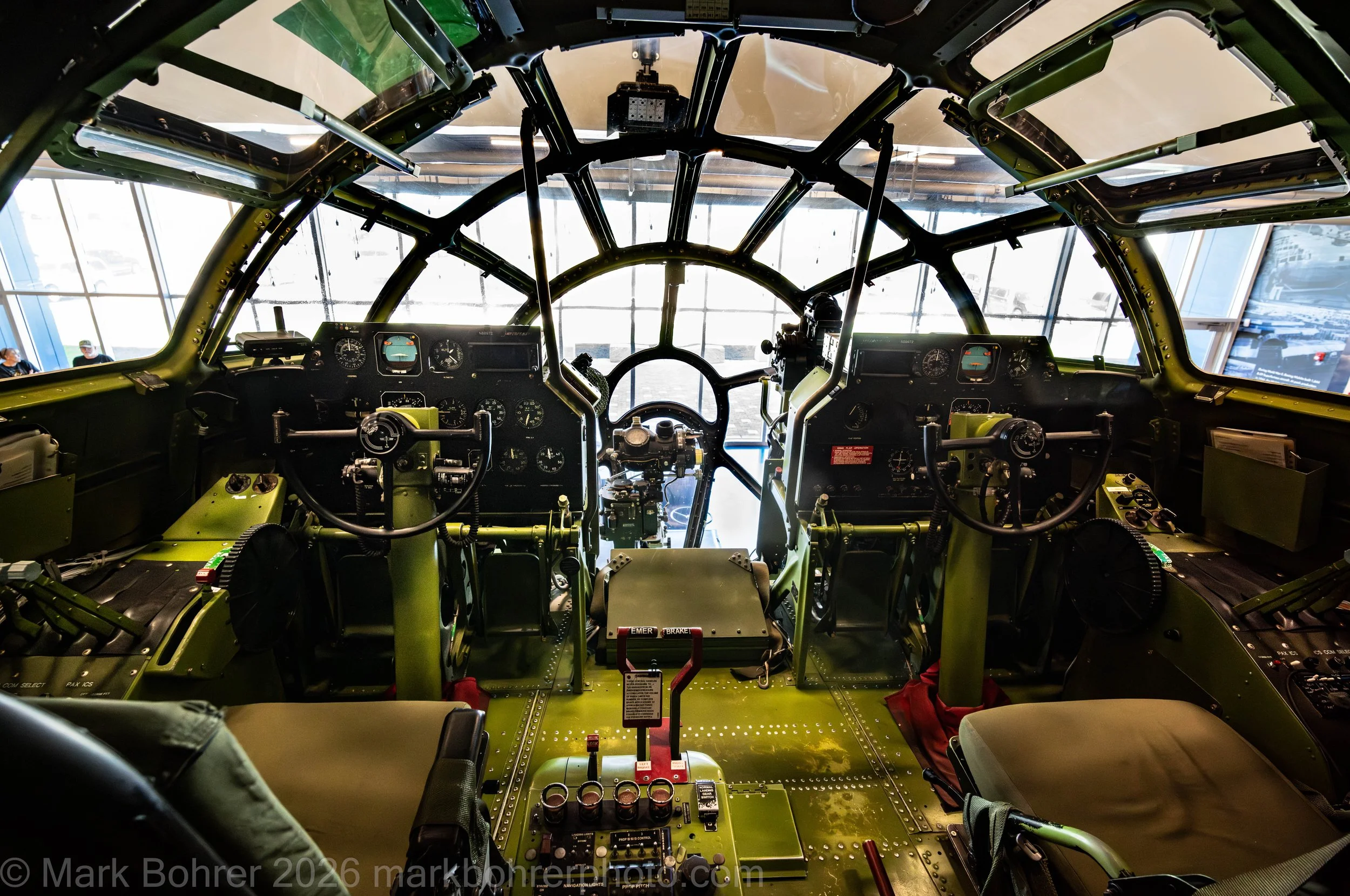
B-29 Doc pilot’s view
Touring the inside, the cabin was more spacious than a B-17, with a big forward glass house. Pressurization and heating made B-29s much more comfortable than the unpressurized, unheated B-17. It gets cold and the air is thin up at 31,000 feet. B-17 aircrew had heated flight suits that only took the edge off the cold, and oxygen masks that were sometimes finicky.
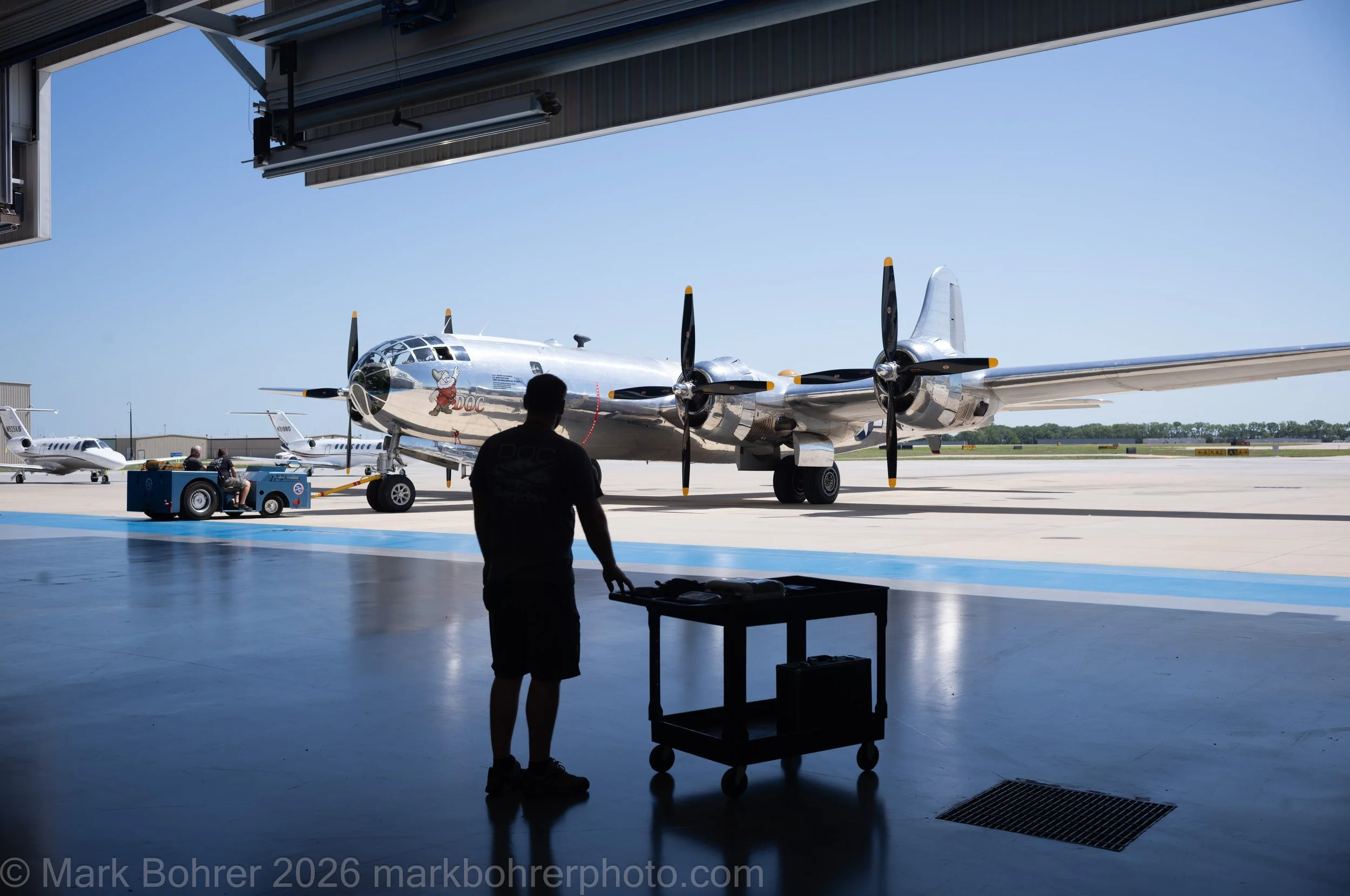
B-29 Doc rolling out
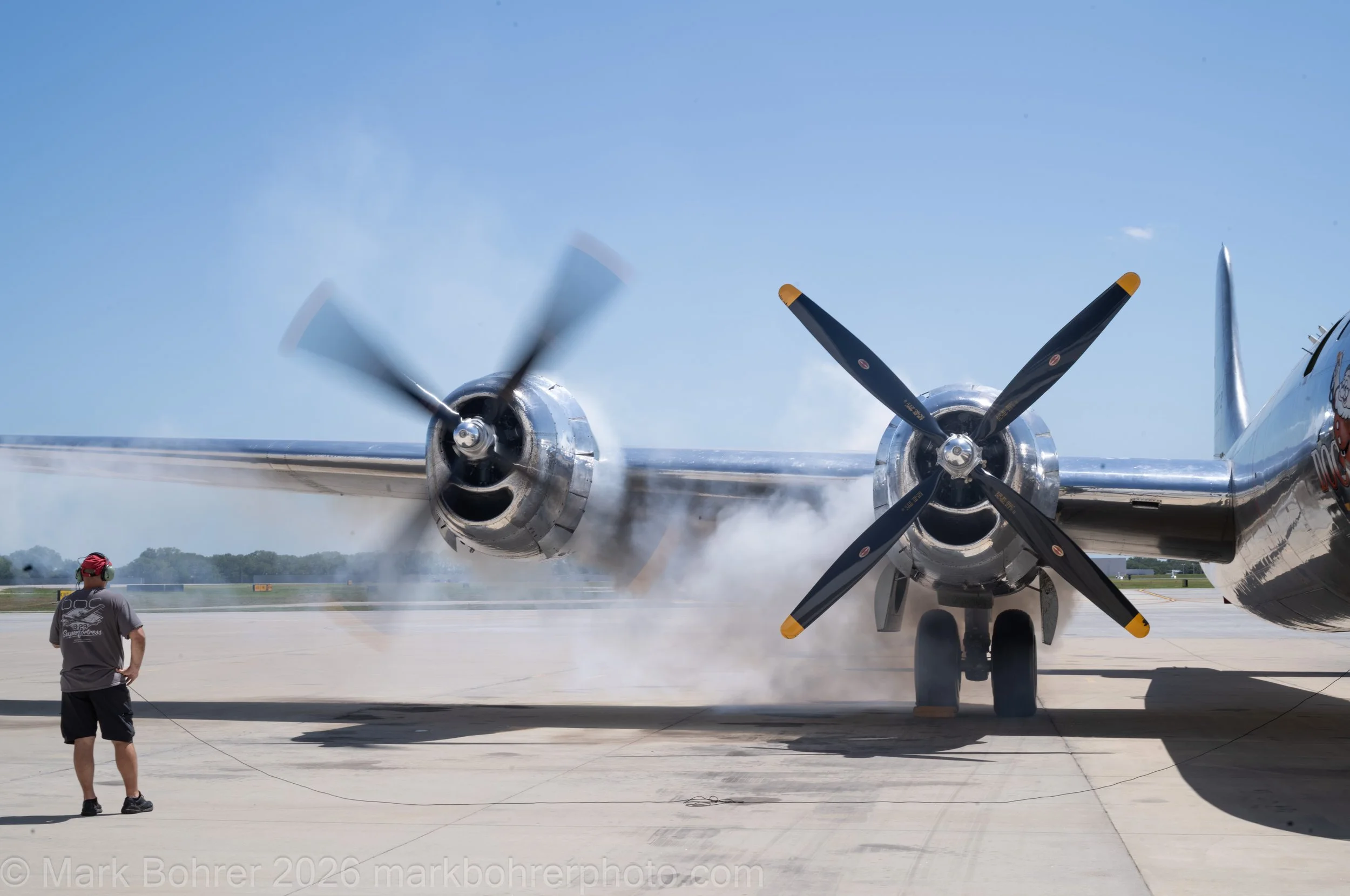
Starting up
The day we were at Doc's hangar, they pulled the plane outside for engine runup tests, with each engine tested by itself. First there's a cough of bluish exhaust and hesitant engine rumbles, followed by a steady roar and a smoothly spinning propeller. Lighting up an entire squadron of 10-16 aircraft with each plane spinning all four props at once must have been deafening, smoky - and awe-inspiring.
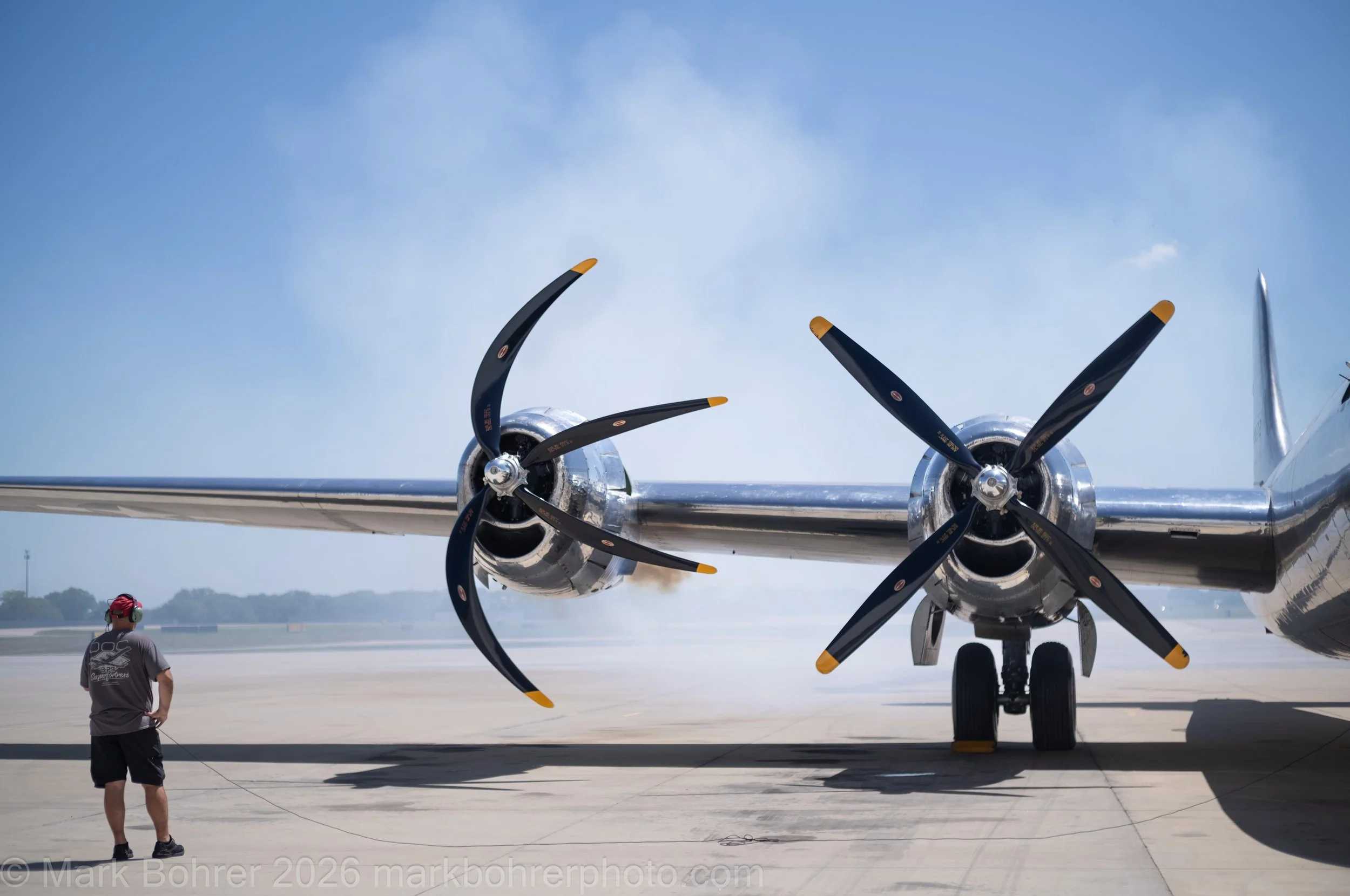
Doc’s noodle prop?
I posted a couple pictures of Doc on Facebook after our visit. High school friend Bill Rosauer had just seen the only other airworthy B-29 in existence, Fifi. When he saw my pictures, Bill suggested a story on Doc for Viewfinder. It only took me a year to write it - sorry Bill!
Shot Notes
Slower shutter speeds give a blurred propeller, with speeds down to 1/40 second or slower for a full prop circle. This depends on prop rotational speed, and shows best when the plane faces a strong light source. I forgot this and only went as slow as 1/90 second, sufficient for some blurred arcs of the quickly-spinning B-29 propeller.
I decided to try freezing the prop motion, attempting an electronic shutter speed of 1/6400 second. What I got was a spaghetti-noodle prop, a prime example of rolling shutter effects. (Trust me, steel B-29 propellers shouldn't bend in the wind like this.) Electronic shutters in the Leica M11 and most other digital cameras scan the sensor one line at a time. Different parts of the prop get scanned at different times, resulting in strangely dislocated shapes for the moving blades. This is similar to what happens with fast mechanical shutter speeds, when only a moving slit travels across the film or sensor as the second shutter curtain starts to close before the first curtain can fully open. Either way, you get interesting subject distortion. I decided to stick with the prop blurs I had already.
21mm used to be the widest focal length offered in Leica’s M-mount. Then there was the 15mm f/8 Hologon, a Zeiss design in M-mount. The Tri-Elmar-M 16-18-21mm f/4 ASPH introduced in 2006 was the first really usable ultrawide for the Leica M, but it wasn’t until the M10 brought live view focusing that ultrawide fields of view really worked on the M. f/4 is a bit slow for an airplane interior inside a hangar. Laowa’s 15mm f/2 Zero-D Dreamer lens solves that problem. Focusing through live view is most accurate. When rangefinder focusing didn’t match live view (or the lens’ distance scale) on three different copies of the Laowa lens, I sent the third copy to Don Goldberg for calibration. I wanted a good working copy, even if it cost me a little more. Don did his best and improved it, but told me this lens had the most imprecise rangefinder focusing cam he’d ever seen.
I shot all other non-flying Doc pictures with a 35mm f/1.4 Summilux-M ASPH FLE II except the Albuquerque tarmac shot in the rain. The flight shot is cropped from a 90mm f/2.8 Tele-Elmarit-M adapted to a Leica SL.
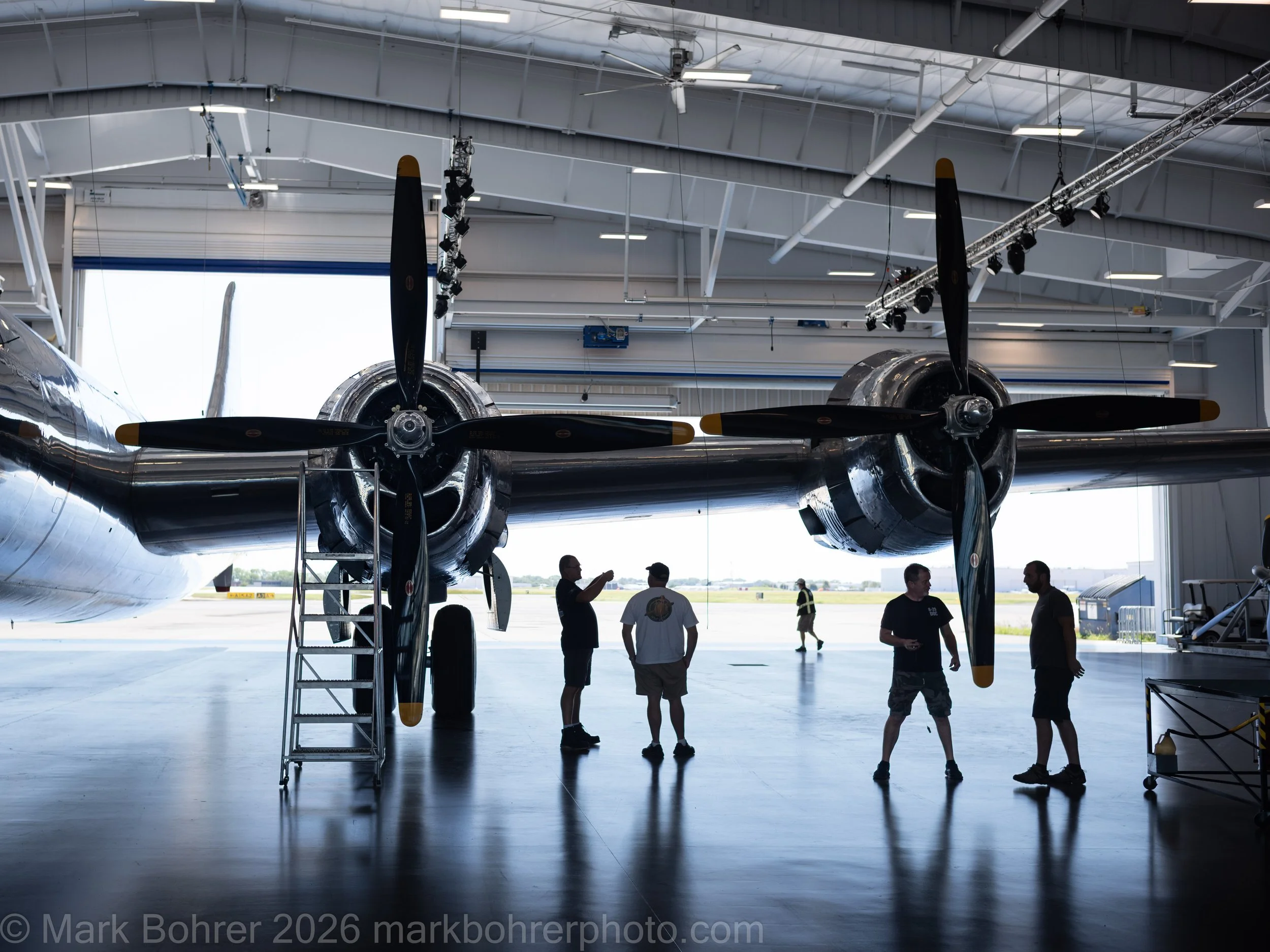
Casual Warbird inspection - Maintenance takes a lot of people!
More Information
Air & Space Forces Magazine (Feb. 27, 2018), Doc’s Saga. Retrieved from https://www.airandspaceforces.com/article/docs-saga/
Air Force (nd), General HENRY. H. ARNOLD. Retrieved from https://www.af.mil/About-Us/Biographies/Display/Article/107811/henry-h-arnold/
Air Force Historical Research Agency (nd), The Birth of the United States Air Force. Retrieved from https://www.dafhistory.af.mil/About-Us/Fact-Sheets/Display/Article/433914/the-birth-of-the-united-states-air-force/
Airplanes Online (nd), Boeing B-29 Superfortress Development, Design and Specifications. Retrieved from https://www.airplanes-online.com/b29-superfortress-design-development-models.htm
B-29 Doc (nd), The B-29 Doc Story. Retrieved from https://www.b29doc.com/docs-story/
Kirtland Air Force Base (nd), Part 1 - A case study in modernization: General Henry ‘Hap’ Arnold, the B-29 Superfortress, and visions of an independent Air Force. Retrieved from https://www.kirtland.af.mil/News/Commentaries/Display/Article/3233705/part-1-a-case-study-in-modernization-general-henry-hap-arnold-the-b-29-superfor/
National Museum of the United States Air Force (nd), Invasion Plans. Retrieved from https://www.nationalmuseum.af.mil/Visit/Museum-Exhibits/Fact-Sheets/Display/Article/196196/invasion-plans/
Richard H. Campbell and Paul W. Tibbetts (2005), The Silverplate Bombers: A History and Registry of the Enola Gay and Other B-29s Configured to Carry Atomic Bombs. McFarland & Company.
Spectrum News 1 (Jul. 26, 2022), What's up, 'Doc?': Restoration of B-29 WWII bomber a remarkable journey. Retrieved from https://spectrumnews1.com/wi/green-bay/news/2022/07/25/b-29-wwii-bomber--doc-
Trevor Nevitt Dupuy (1962), The Military History of World War II (18 Volume Set). Franklin Watts.
Vintage Aviation News (July 30, 2025), Ghosts of the Superfortress Graveyard: The Untold Stories of B-29 Survivors from China Lake, Retrieved from https://vintageaviationnews.com/warbird-articles/ghosts-of-the-superfortress-graveyard-the-untold-stories-of-b-29-survivors-from-china-lake.html
Wright Patterson Air Force Base (Aug. 14, 2018), FLASHBACK: “Battle of Kansas” and the Birth of the Superfortress. Retrieved from https://www.wpafb.af.mil/News/Article-Display/Article/1602130/flashback-battle-of-kansas-and-the-birth-of-the-superfortress/
